
Magnesium and Hydrochloric Acid
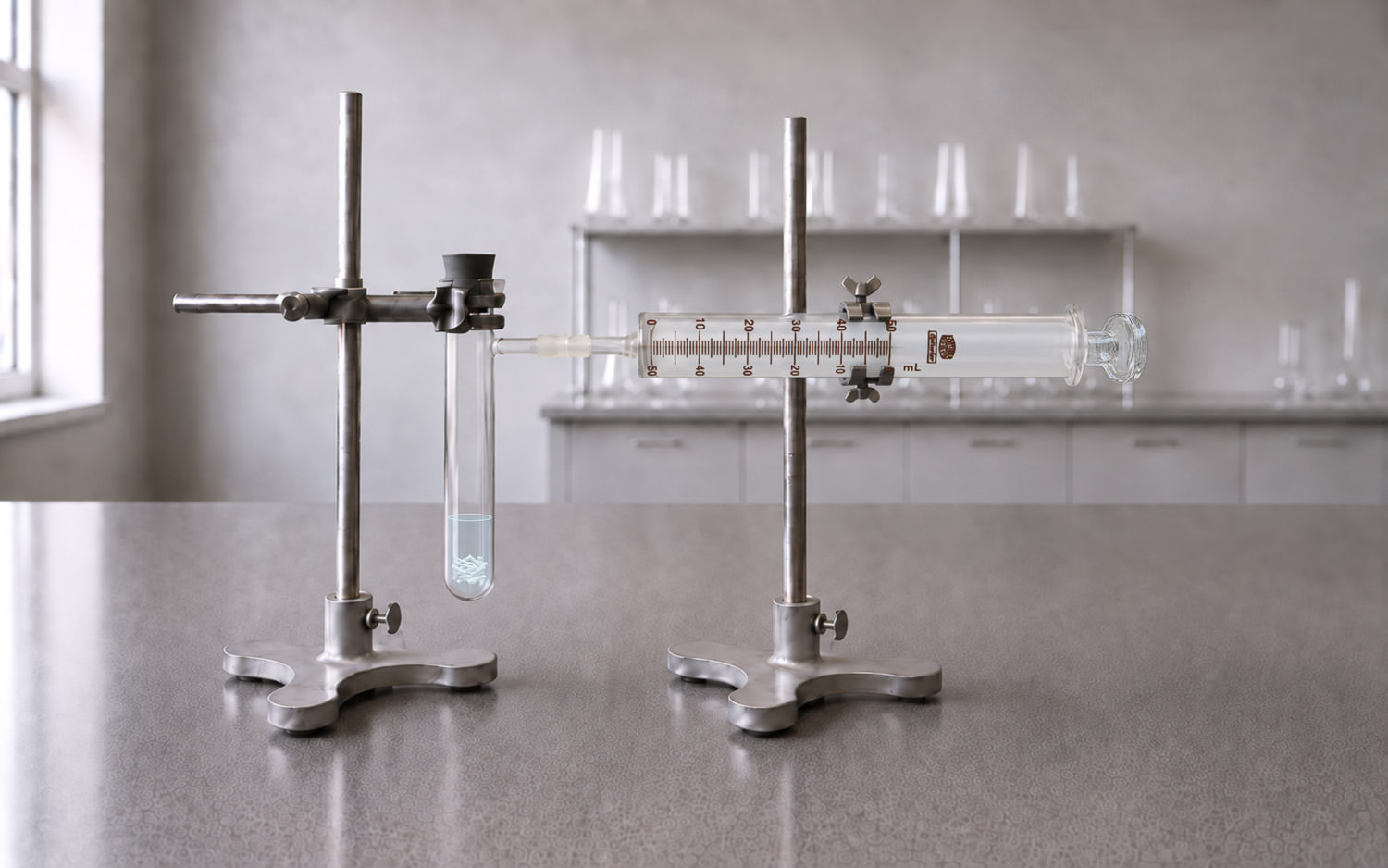
Magnesium reacts with hydrochloric acid to form hydrogen gas. The gas produced is collected in a syringe, and its volume is recorded as a function of time. Learners determine the times at which each additional 5 mL of hydrogen has been produced.
From these measurements, they calculate the amount of hydrogen formed as well as the remaining concentration of hydronium ions and plot the reaction progress in a concentration–time diagram. On this basis, both the average and instantaneous reaction rates are determined quantitatively.
The simulation represents the same reaction process using a simplified kinetic model. Reaction time and hydrogen volume are calculated continuously and displayed in a volume–time diagram. The simulated data can be used to determine the amount of hydrogen formed and the remaining concentration of hydronium ions.
The simulation is based on defined model assumptions and idealised conditions. In addition, measurements from the real experiment can be entered and compared directly with the simulated reaction progress.
The simulation is designed as an integral part of the experimental learning sequence. It does not replace the real experiment but complements it by providing a controlled, model-based perspective.
Its particular value lies in linking simulation, real experiment, and mathematical analysis. Learners investigate the same reaction process first under defined model conditions and then experimentally. Differences between simulated and experimental data are not concealed but instead become the starting point for reflecting on experimental conditions, model assumptions, and the limitations of the model.
The simulation does not replace the real experiment. It expands the scope of what can be learned from it. It can be integrated directly into an experimental lesson, used for preparation or follow-up, or incorporated into blended-learning and hybrid learning environments.